
Fifth Wall’s Brendan Wallace On Spotting Real Estate’s Next Hot Tech Early
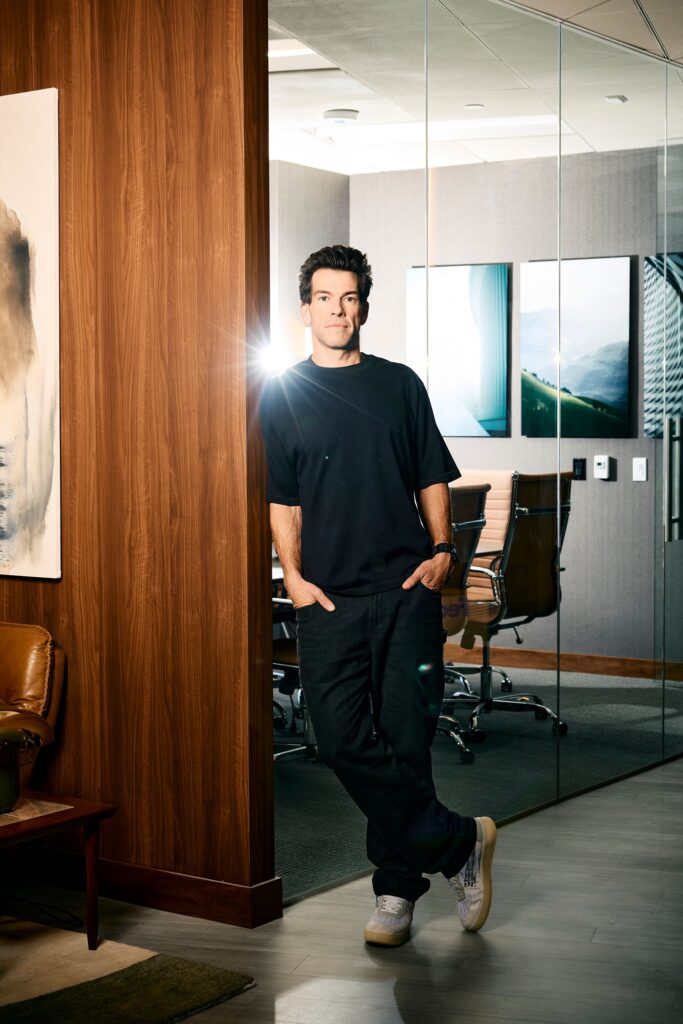
Stratford Wallace’s family had owned a lot on the Southeast corner of 41st Street and Eighth Avenue in Manhattan since 1886.
Then, in the early aughts, the State of New York used eminent domain to wrestle the land from the Wallace family’s control.
Wallace told Forbes in 2008 that, had he been given the chance to negotiate, he would have asked for $30 million. However, according to his son Brendan Wallace, the eminent domain declaration left him no choice but to accept the $12 million offered by the Empire State Development Corporation, the state’s economic development agency.
Today, that lot, along with several adjacent others, is the site of the New York Times Building.
The younger Wallace, 44, is the founder of Fifth Wall, which bills itself as “the largest investment firm focused on technology for the built environment.” Since its inception, the firm has received commitments of approximately $3.1 billion from roughly 115 limited partners, including CBRE, Hilton, Hines, Marriott, Public Storage, Related Companies and Starwood.
Wallace recalls walking around the city as a child with his father, visiting his father’s properties and developing an early obsession with land in the process. (Stratford Wallace died in 2022 at age 85.)
“Land is the input to the entire economy, and the one asset they’re not making more of,” said Wallace. “And, it’s anti-inflationary. If you look at land values, they have outpaced basically every other measure of nominal and real growth.”
The Los Angeles-based Wallace, a sports enthusiast and history buff, was a newlywed of three weeks as of his late September conversation with Commercial Observer. With degrees in political science and economics from Princeton and an MBA from Stanford, he is also a veteran of Goldman Sachs and Blackstone who could have worked in any industry.
But, from his earliest days, there was little doubt that his future would find him closely connected to real estate.
This interview has been edited for length and clarity.
Commercial Observer: Congratulations on your recent wedding. Where did you and your wife meet?
Brendan Wallace: She’s a big extreme sports athlete, and we met on a mountaineering trip. I have a ski house in Park City, Utah, and I have a group of friends I go backcountry skiing with. It was a chance encounter on one of those trips.
Where are you from originally?
I was born and raised on East 91st Street in Manhattan.
Talk about your earliest exposure to real estate.
In the late 1970s, my father and his brother started buying run-down real estate in Times Square: nail salons, a kung fu studio, a Chinese restaurant. Times Square built up around them. I have a deep fascination with land. It’s an opportunity hiding in plain sight that people don’t think about.
When my father bought this real estate, he didn’t have the money to develop it. They were run-down buildings. So, he went to a handful of developers and said, “I’m going to lease you the ground, but I’m never selling the ground.” He basically converted a bunch of old, run-down assets into ground leases in Times Square.
Tell me about the Times building site.
It was pretty run-down. New York City exercised eminent domain to condemn the property as blighted, and they basically gifted it to the New York Times to build their tower.
My dad fought it all the way to the U.S. Supreme Court, and lost. The site was underdeveloped, but saying something is blighted and should therefore be condemned, and that the public sector should use its authority to coerce control of land, he viewed that as an abuse of power.
[In 2003, Stratford Wallace told correspondent Mike Wallace — no relation — on “60 Minutes” that the site was “not blighted property.”]
When you think about it now, did watching that happen have any effect on how you conduct your business?
In one way, yes; in another way, no. I’ve always been fascinated by how cities use eminent domain as an instrument of urban development and how it can lend itself to overreach. But what I do think it instilled in me is a really deep appreciation for land.
If you look at GDP growth and land value appreciation, land consistently outpaces it because it’s basic economics that in a world of growing productivity, value accrues to the scarce asset. Land across from the Port Authority Bus Terminal — the hub for the tri-state area to enter the most important city in the U.S. — is extremely valuable land.
My dad loved the history of New York City. When I was a kid, I would go with him to collect rent, and he would point out buildings, and who did what, and who bought what when. That lore, that mythology of real estate, is something I always loved. So, I wanted to be in real estate ever since I was a kid. My dad shaped that in me. Real estate is in my blood.
When I graduated from Stanford, I got a job at Goldman Sachs in investment banking, but I really wanted to be a real estate person. I told them I wouldn’t be joining the firm unless I could be in the real estate group. They promptly informed me that’s not how it works, and I was like, “Well, that’s how it’s going to work for me.” So they put me in the real estate group.
After Goldman Sachs, you worked at Blackstone with Jon Gray, who is now the company’s president. What was that like?
I worked in the real estate private equity group around the time Jon took over and worked on the buyout of Sam Zell’s company, Equity Office Properties Trust, in 2007. [Zell, who died in 2023, sold the 573-property portfolio to Blackstone for $39 billion.]
I learned an enormous amount from Jon. He applied a technocratic precision to the real estate industry I had never experienced before. That was profound for me.
I moved to Los Angeles to help sell off those [Equity Office Properties] assets, then that segued into the buyout of Hilton Hotels, which was the high-water mark of the bull market cycle. Because, right after the buyout of Hilton, the market crashed.
What was the most important thing you learned from Jon?
The thesis behind the Equity Office Properties buyout was that the price of the public company was less than the price of the individual assets if you sold them off. So, you could buy wholesale and sell retail.
That arbitrage, that asymmetry, existed in a very temporary context, and it was a product of the dynamics of public REITs. Jon Gray very astutely saw that. His view was that these assets would trade on a per-pound basis eventually. And, sure enough, they did. Seeing someone articulate that so clearly and be so committed to that vision really impressed 23-year-old me.
It impressed on me that while we love to believe that markets are efficient, even at the largest, most institutional scale, they can, in the short term, be extremely inefficient, and the shrewdest minds are those that identify the eventual collapse of those asymmetries and the reversion to parity, and get in front of it. That was the lesson I really took away from the Equity Office trade.
At Fifth Wall, we’ve been very good at identifying new asset classes before they become new asset classes, and tha
Source: commercialobserver.com — article syndicated from the publisher’s feed; all rights remain with the original publisher.