
Data Centers: There’s So Much to Talk About
All eyes were on the most controversial asset class in America during Commercial Observer’s Data Centers Development and Infrastructure Forum, held Oct. 6 in Midtown Manhattan at the City University of New York Graduate Center.
Experts across data center law, construction, investment and development discussed the past, present and future of the asset class, with particular emphasis on the innovations of AI technology and recent investment trends. They also discussed how the evolution of public opinion has made data centers a hot topic on Capitol Hill and regional statehouses alike.
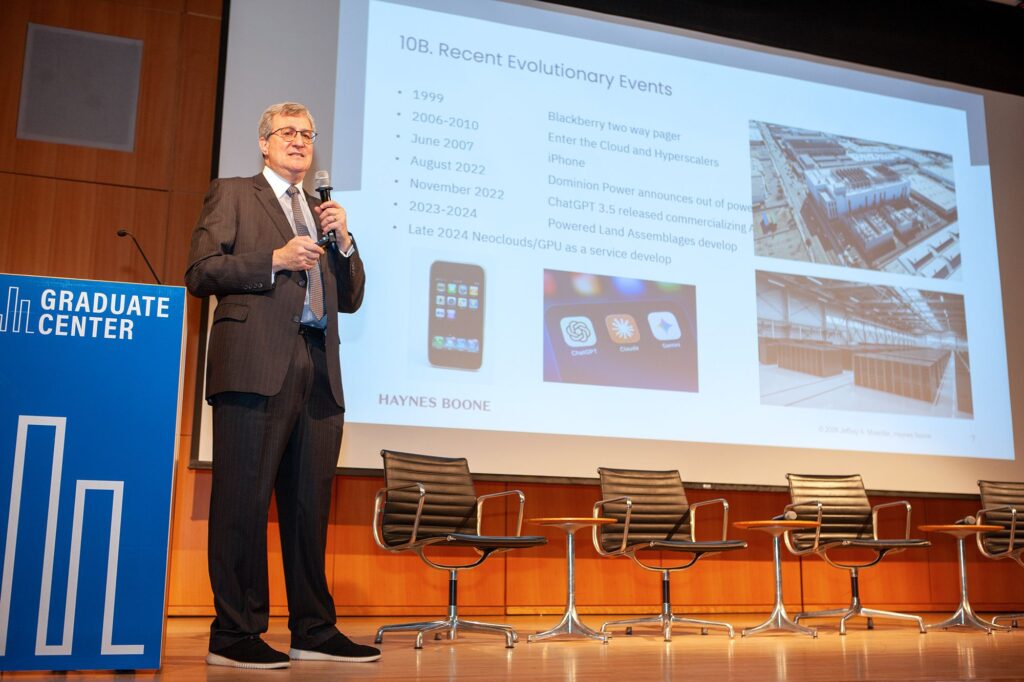
The forum began with a presentation by Jeffrey Moerdler, partner at law firm Haynes Boones’ data centers and digital infrastructure practice group, who opened his remarks by calling data centers “the fourth and maybe the fifth industrial revolution.”
Moerdler compared the recent development of the asset class and AI technology to the discovery of water and steam power in the early 19th century, electricity and mass production in the late 19th century, and computing and digital technology in the 20th century.
He then zeroed in on a pair of trends. First, he emphasized that the future of AI is in urban and suburban inference data centers — low-latency data centers trained to deliver AI outputs to users in densely populated cities, rather than large campuses in rural locations.
“In the last year or so, I’ve seen my clients that have those kinds of facilities at capacity sell out the [computing] capacity faster to smaller users that need the end point of their AI network to be local,” he said.
Moerdler also dampened sentiments toward neocloud computing companies — specialized on-demand cloud networks for AI models, rather than general purpose internet, that lease space in data centers — which he described as a short-term business model without long-term income sources.
Jeff Moerdler delivers the market report and outlook at the Commercial Observer Data Center Development & Infrastructure Agenda. PHOTO: Greg Morris
“Neoclouds are new companies, there are a zillion of them popping up everyday, they have a zero credit rating, and they usually have someone with a very deep pocket backing them,” he said. “I worry about whether this is WeWork 2.0.”
The first full panel of the day, moderated by Michael Vardaro, a managing partner at law firm Zetlin & De Chaira, examined where commercial real estate meets AI and what investing in the future of digital infrastructure will look like.
Sam Stockdale, managing director of power and infrastructure at Link Logistics, broke down the differences between data centers from as recently as seven years ago and those being built today. The older 30-megawatt or 40-megawatt facilities are now dwarfed by data centers that today demand one or two gigawatts of power.
“That’s the largest difference just because it, of course, commands a completely different scale of investment to achieve development and delivery of that type of infrastructure,” he said.
Stockdale added that the data center revolution is more than just about leasing the technology to firms like OpenAI and Anthropic, but it is “really about the digitization of the entire economy.”
Peter C. Lewis, founder and chairman of Wharton Equity Partners, said that in his four decades of investment experience, the growth of data centers and AI real estate has been “without a doubt the greatest change seen in my career, times 10.” Yet, Lewis warned that not every developer with experience in industrial real estate will be able to successfully make the shift into data centers due to the inherent complexity of the asset class.
“This is a really sophisticated game,” he said, comparing it to investing into a pie chart that keeps expanding and can go wrong at any minute. “This is the beginning of a major tidal wave, and I really think the Street, in general, is underestimating the demand and reach of this.”
Lewis added that data center development, while fraught with risk, creates “returns like I’ve never seen in my career, by many multiples.”
Amir Abdu, a managing director at BGO’s U.S. investments team, emphasized the increasing number of delays in data center developments. Abdu said the entire industry, including the capital markets side of the business, now must confront the changing winds of public opinion.
“Previously, power was the single dominant supply constraint in the industry, but the new issue that we’re all grappling with is this politically charged environment nationally,” he said. “It really runs the gamut across the political spectrum. … It’s not just a Democrat or Republican thing.”
The morning’s second panel, moderated by Nicole Fenton, partner at HSF Kramer, examined the data center transaction life cycle, with an emphasis on the land use conundrum.
Gavin Flynn, principal at Blue Owl Capital, said that powered land is the key to underwriting any data center deal, but permitting might be even more important, as powered land has “very little value” if you can’t build or operate a data center on it — an issue that puts utility players at the crux in any potential data center development.
“Some of the requirements from utilities today, around clawback provisions, you’re looking at minimum charges, letters of credit — on large campuses — these are probably hundreds of millions of dollars outlayed before you even have a tenant or a clear timeline to revenue,” he said.
Gavin Flynn speaks at the Commercial Observer Data Center Development & Infrastructure Agenda. PHOTO: Greg Morris
James Nemeroff, a director at capital markets firm Ackman-Ziff, speaking from an investor’s perspective, said that capital isn’t looking to solve a developer’s questions when it comes to data centers, and that those sponsors who have secured the necessary permits and leasing agreements are likely to have an easier time securing capital. That goes for both the short term and the long run.
“The people that can take things as far as possible and check as many boxes as possible — as ultimately you’re solving for an end user, a long-term lease — that’s what’s ultimately getting financed,” he said. “There are guys getting close to 100 percent financing on construction, if you can get to the point of leasing to an Amazon.”
Andrew Bernardin, a senior vice president at Starwood Capital Group, argued that data centers are more than a traditional real estate project and that the powered shell is “probably the true real estate investment,” as energy considerations are paramount when it comes to financing.
“You need to be really safe, and protect
Source: commercialobserver.com — article syndicated from the publisher’s feed; all rights remain with the original publisher.