
Why Boston Has One Of The Nation’s Hottest Retail Markets
Construction of new retail space in Greater Boston has reached its lowest level in two decades, but demand remains hot as fast-casual restaurants, fitness concepts, discount stores and other businesses look to expand.
This has created a dynamic not seen in the region’s weaker lab and office markets: Landlords have the upper hand and can pick from a range of competing tenants.
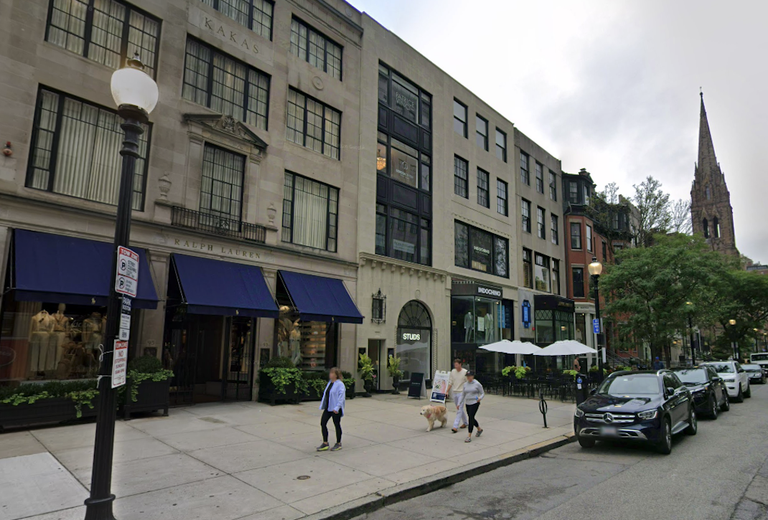
Google Maps Boston’s Newbury Street retail corridor
“Boston is one of the healthiest cities in America right now on the retail side,” Bialow Real Estate CEO Corey Bialow said Wednesday at Bisnow’s Boston State of the Market event, held at 116 Huntington Ave.
“If you have a good retail site in the suburbs or in the Back Bay, Seaport, Fenway, there’s going to be five or six offers out on that one space.”
The region’s retail vacancy rate sat at 3.5% in the third quarter, according to Marcus & Millichap’s latest report, which called it “one of the tightest markets in the nation.” The firm reported the national retail vacancy rate as of June was 4.9%.
Boston-area retail deliveries this year are expected to reach their lowest point since 2007, according to M&M, and most of these spaces consist of smaller-format storefronts of less than 20K SF. It said the region over the last five years has averaged 500K SF of deliveries, while most years before 2021 surpassed 1M SF.
Retail sales in the Boston area increased 5% over the 12 months ending in June, the only market outside of the Sun Belt to reach that mark, M&M found.
“We really haven’t caught up to the demand,” Bialow said. “We’re really not seeing any product coming out, especially in the suburbs.”
Bialow said it is still “very much so a landlord’s market,” with owners chasing what he calls nontraditional “Amazon-proof” tenants across food, entertainment and services.
Consumers also continue to flock to high-end shopping destinations like Newbury Street, which has ultralow availability while boasting demand from national and international luxury retailers.
Boston Realty Advisors founder Jason Weissman said his firm on Wednesday listed a four-story retail building for sale at 83 Newbury St. that is fully leased to Zimmermann, Warby Parker and AER on Newbury. He said he anticipates high investor demand for the property because of its location.
Bisnow/Jon BanisterBoston Realty Advisors’ Jason Weissman
“It’ll be a feeding frenzy,” Weissman said.
More than $162M in transactions occurred on Newbury Street in the second quarter across nine deals, including New York-based Acadia Realty’s $113.5M acquisition of two buildings home to Chanel and Cartier in April. The deal came to a whopping $6K per SF.
In addition to high-end stores, the discount retail sector has been booming. Discount stores have represented 30% of openings nationwide this year, up from 28% last year.
Ross Dress for Less has opened 115 stores across the country this year, including 51 over the last two months. The discount retailer expanded into Massachusetts for the first time this year and is scheduled to open three stores in Danvers, West Springfield and Chicopee in October and March, according to MassLive.
Ross Stores Senior Vice President of Real Estate Michael Shanahan said that in addition to location, two key factors the firm considers when deciding where to open are the neighboring tenants and the reputation of the landlord.
“We’re making a bet on the center and the landlord to replace tenants quickly and keep driving traffic,” he said. “Co-tenancy is the biggest piece right now.”
The health and wellness sector has also been “on fire,” Samuels & Associates Vice President of Leasing Rachael Diharce said, including tenants like medical spas, boutique fitness concepts and medical offices. And she said many consumers still want to do their shopping in person.
“People want to go into stores,” Diharce said. “They still want to touch. They’re still purchasing grocery in stores.”
Samuels owns more than 12M SF of commercial, mixed-use and residential real estate across the region, including The Launch at Hingham Shipyard, which includes 203K SF of retail and dining.
Although the retail sector is booming on most fronts, restaurant businesses are seeing mixed performance in the urban and suburban markets.
Diharce said fast-casual and fine dining options have done well in urban settings, but midtier full-service restaurants — “your Wednesday night spot, not your anniversary spot” — have lagged, with some seeing double-digit sales decreases year-over-year.
Bisnow/Jon BanisterGoulston & Storrs’ Vanessa Moody, HFA’s James Owens, Ross Dress for Less’ Michael Shanahan, Samuels & Associates’ Rachael Diharce, Bialow Real Estate’s Corey Bialow and WS Development’s Lindsay Desmettre
“I would say that’s probably one of the larger challenges in the urban footprint, because you’ve got the high rents, you’ve got the high occupancy costs, and if you’re not reinvesting, it’s really hard to stay relevant in that space,” Diharce said.
When landlords have restaurants close, the second-generation space can create an opportunity to bring in a business that will draw more customers, but the type of tenants owners look for differs between the city and the suburbs.
“Rachael’s looking for a chef-driven concept that’s a unicorn to fit really well in the city,” WS Development Vice President of Leasing Lindsay Desmettre said. “You go out a little bit farther into the burbs, and something a little bit more elevated than [TGI] Fridays or Bertucci’s really transforms your center.”
One growing full-service chain that Desmettre said is drawing more foot traffic to suburban retail centers is Tavern in the Square. WS owns suburban retail districts like The Street on Chestnut Hill, the Marketstreet Lynnfield and Legacy Place in Dedham.
“It’s really creating an environment that’s busy and that adds so much to
Source: www.bisnow.com — article syndicated from the publisher’s feed; all rights remain with the original publisher.