
Welcome to Data Centerville, U.S.A.: How One Asset Class Changed Loudoun County, Va.
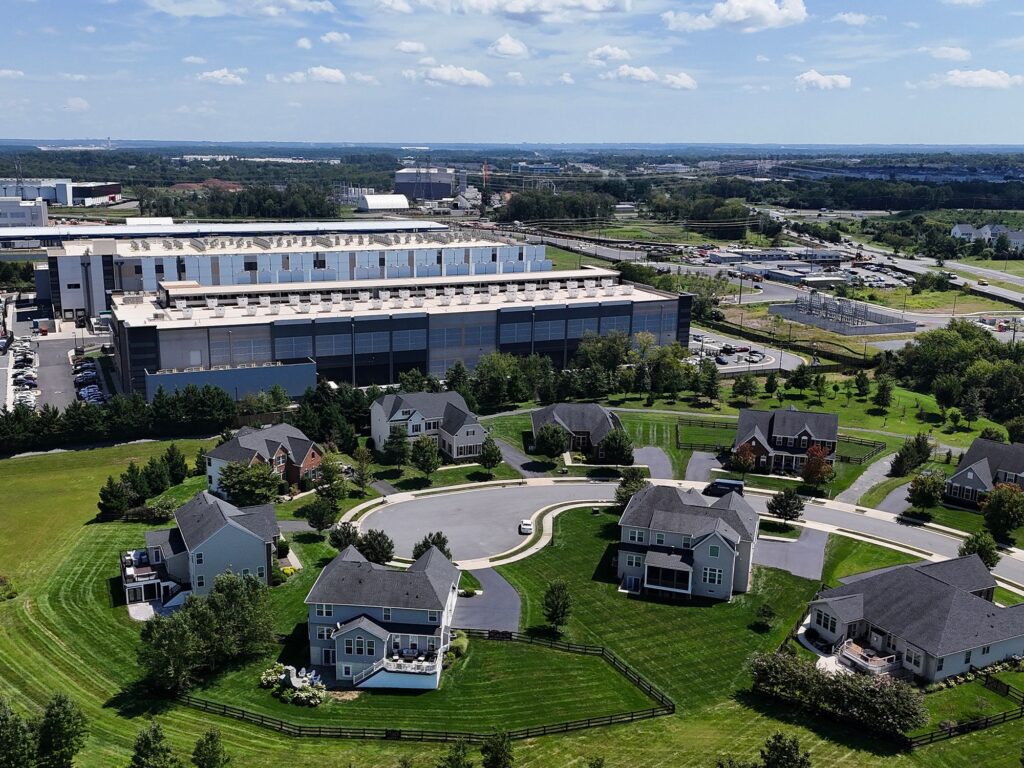
Driving past Dulles International Airport and turning onto the newly paved Loudoun County Parkway, stretching six pristine lanes across, the first thing that strikes any observer is the sheer size of the data centers that pepper the immediate horizon.
CloudHQ’s LC4 campus is three stories and 1.5 million square feet.
QTS’s Ashburn Shellhorn complex runs along the highway and stretches 24 acres deep into a wooded glen.
Digital Realty’s mix of six high-capacity buildings is nestled together over 96 acres and spans a cumulative 1.7 million square feet.
Roughly as tall and windowless as an NBA arena, but often the length of three or four NFL football fields, the data centers that define Loudoun County’s famous “Data Center Alley” stand like endless, imposing monoliths along the road of America’s increasingly digital future while simultaneously calling its present economy into question.
For John McAuliff, a 34-year-old Virginia delegate who took office this year after winning an election largely on a platform to limit future data center development, the changes across his Northern Virginia district are disquieting, to say the least.
“When Dulles was built in the 1970s, it was built on a farm. Loudoun County used to have more dairy farms than anywhere else in the country. There is now one left,” McAuliff said. “Today, we have more data centers than anywhere else in the world.”
The real estate technology that powers social media, cloud computing, and the rapidly evolving artificial intelligence revolution does not lie in Silicon Valley or Beijing, as some might assume. Instead, it rests in sleepy Loudoun County, a shire of rolling hills, Blue Ridge Mountain peaks, and dense woodlands in Northern Virginia about 36 miles outside of Washington, D.C., and one founded in 1757, nearly 20 years prior to the American Revolution.
With 253 existing data centers — collectively spanning 49 million square feet, and making up 25 percent of the United States’ entire data center development — and dozens grandfathered in for future development, Loudoun County is unquestionably the world’s data center capital.
It is also America’s richest county, with a median household income of over $170,000, where its 440,000 residents enjoy the lowest property taxes in the region, and reap the benefits from a local government that derives $1.3 billion per year in corporate and real estate tax revenue from the hundreds of data centers operating within county lines.
An Amazon Web Services data center stands near several houses in Stone Ridge, Va. PHOTO: Anna Moneymaker/Getty Images
“We’ve had a AAA bond rating with every bond agency over the last 15 years, we’ve been one of the fastest-growing counties in the U.S., and we’ve built 10 schools over the last eight years,” said Mike Turner, vice chairman of the Loudoun County Board of Supervisors, an elected body of nine members that governs the community, and a man who doesn’t see the same dangers with data centers as McAuliff. “Loudoun County is a great place to live, in large part due to our tax revenue from data centers,” Turner said.
It is also a locality quickly becoming divided over a mysterious asset class that now powers modern life, and one that also demands tremendous amounts of electricity and water while emerging in the eyes of many Americans as a physical manifestation of the fears that AI could potentially threaten human life across the planet.
“People first started asking, ‘What is the big gray box that has sprung up next to my house or my kid’s school?’ and then it morphed into a wider understanding of the energy impacts,” said McAuliff, a Democrat who won his race against a Republican incumbent by a mere 636 votes in a district President Donald Trump carried by seven percentage points in the 2024 presidential election.
“People started to recognize the connection between higher electric bills and data center developments, and it led to an awakening of understanding here,” McAuliff added.
However, inside the data centers themselves, the co-location firms that power the American economy — and which serve as the nervous system for banking, finance, communication, cloud computing, Zoom meetings, online shopping and AI assistance — argue they have become more energy efficient as demand for their services has increased, largely thanks to modern equipment, liquid cooling, lower latency levels, aisle containment and high-efficiency power distribution units.
Kevin McNulty, director of public affairs at owner and operator Digital Realty, noted on a tour of his Loudoun County facility that the firm’s clients — meaning those who rent computing shelf space within a Digital Realty data center — range from the biggest tech companies to hospital systems, public schools, universities, financial institutions, and even local mom-and-pop Virginia businesses.
“Everybody in the modern economy is supported by a data center,” McNulty said.
Walking through Digital Realty’s data center in Loudoun County, one is struck by the science fiction quality inside the building.
Futuristic revolving glass and a gray metallic sheen define the lobby, where the several layers of security resemble Skynet headquarters, while the windowless corridors that stretch within for hundreds of feet in one direction are defined by silence and locked doors, creating the corporate unease of a Philip K. Dick story.
In the server rooms, rows of fenced computer server cages look like hundreds of vintage VCRs stacked atop one another, but they might as well hold one of Isaac Asimov’s Multivac underground supercomputers, given their relative power demands. Literary and cinematic comparisons aside, the assets themselves are home to nothing more than piping, heating, cooling and computing.
“If you look at the way the State of Virginia is formatting data center construction, they’re really concentrating in places next to highways, in an industrial park or near existing transmission,” said Matthew Gallagher, executive managing director at JLL. “And the biggest tenants are no secret: Amazon, Google, Microsoft, Meta.”
Yet, how Loudoun County attracted these major corporations, and became the nexus for America’s new AI economy, is a story crazier than any piece of sci-fi.
Supercomputer city
When we think of the American internet, Silicon Valley should get credit for inventing the chips that power our iPhones and laptops. Loudoun County, however, is responsible for the fiber optic cables and servers that allow the technology to go wireless and into invisible cloud systems.
As Judge Glock in The City Journal recounts, the U.S. Department of Defense recognized early in the Cold War that any future national computing networks would need to be near the U.S. capital, the intelligence agencies and the Pentagon, leading to the creation of the Defense Advanced Research Projects Agency in 1958, an entity which eventually powered the birth of different iterations of the internet over the next 35 years.
As private companies modified what was known as the World Wide Web in the early 1990s, even creating the first private Internet Exchange Point in nearby Fairfax County in 1992, now-defunct firms like AOL, MAE-East and MCI WorldCom chose Loudoun County as their headquarters. This was mainly due to its established telecommunications network of fiber-optic cables.
Source: commercialobserver.com — article syndicated from the publisher’s feed; all rights remain with the original publisher.