
Toll Brothers underwrites lots for tomorrow’s market, not yesterday’s
As margins for error narrow in homebuilding’s land rules of engagement, boundaries between strategy and tactics have begun to blur.
As slower sales, weaker demand, moderating sales prices and declining margins continue to look for a stabilizing floor, homebuilding land acquisition decision-makers now typically take a more discriminating, granular and real-time look at each deal to ensure it measures up to indefinitely challenging selling conditions.
While many builders contend with land bought in a stronger market that is now becoming a liability, Toll Brothers has spent the last few years raising its underwriting bar and tightening it further. That approach is shaping more than what the builder will pay for land.
It is influencing where Toll considers building, how it structures deals and where it finds opportunity as competitors reassess older purchases.
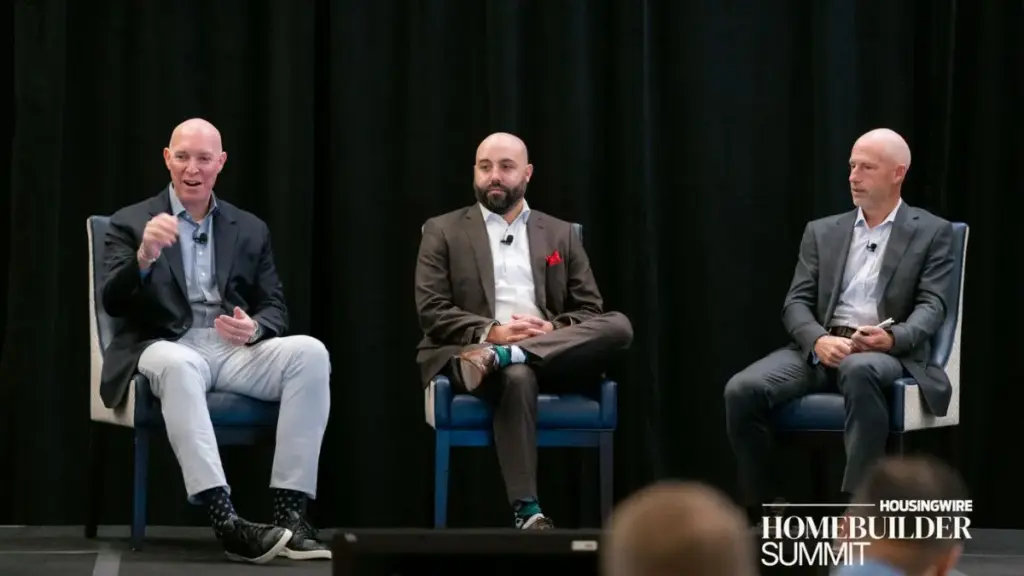
Rob Paul, Texas and Arkansas group president, and Dustin Bowersett, VP of land acquisition for Toll’s Central Florida division, elaborated on the company’s land strategy during a session last week at the HousingWire Homebuilder Summit, moderated by longtime Wall Street housing analyst Dan Oppenheim.
That strategy follows a clear thread. Stricter underwriting, a focus on the best locations, selectivity when sellers won’t budge on price and an emphasis on trusted relationships with land sellers all show how Toll Brothers tries to stay out ahead of a slowing market rather than react to it.
Toll Brothers raises the bar for new land
Toll Brothers began reassessing its underwriting criteria for evaluating land a few years ago. At the time, lots traded aggressively on the expectation that homes would sell quickly and at high margins, particularly in many high-growth Sun Belt markets.
Paul noted that Toll Brothers’ land committee is getting much stricter when evaluating deals. As market conditions tightened, the company course-corrected its approach and began scoring land based on a combination of gross margin and internal rate of return (IRR).
“The increase of that threshold and making the underwriting more strict over the course of the last couple of years has put us in a position where, should the market turn, we retain some value,” Paul said.
This underwriting criteria also considers recent sales performance, while discounting sales performance experienced during the spring, since conditions have worsened since then.
“The sales in the last…60 to 90 days absolutely drive decisions. We’re starting to look at what’s happened in the last couple of weeks,” Paul said.
Essentially, Toll Brothers expects its newer land purchases to pencil even if the market worsens, because they were completed under higher hurdle-rate standards. The finer point is that the market has changed enough to demand a shift in mindset, with Paul arguing that builders should underwrite the conditions they are likely to face, not the ones they operated through earlier in the year.
The Toll Brothers “main and main” advantage
Since its inception, Toll Brothers has abided by a “Main-and-Main” philosophy, characterized by purchasing lots in the best locations, i.e. Main Street. This strategy makes sense for Toll Brothers, which has the highest average sales price of any public homebuilder in the country, coming in at roughly $1 million nationally.
Bowersett noted that, while Toll Brothers’ Central Florida division sells homes between about $350,000 and $5 million, the vast majority of the division’s volume falls in the $850,000 to $1.3 million range.
The bulk of those transactions are domestic move-up buyers, but many are wealthy foreign buyers from Latin America. Regardless of where they come from, they seek top-tier locations in neighborhoods with good schools and a high quality of life.
Another reason validates Toll Brothers’ focus on Main-and-Main locations. Many fringe areas are now struggling as demand for more affordably priced homes softens or stalls. When buyers are plentiful and demand is high, outlying locations can look like smart bets. However, when that demand thins, the gap between prime and peripheral land can widen quickly.
Bowersett pointed to Polk County, Florida, a growing suburban and exurban county located between Orlando and Tampa as an example. During the post-COVID building boom, builders aggressively pursued peripheral land in Polk County. Production builders posted strong absorption rates, developers offered relatively attractive lot pricing and deal structures were easier to negotiate.
Now, as population growth and demand in Polk County moderate, that submarket has lost some luster. In hindsight, Toll Brothers’s decision not to pull the trigger on opportunities there proved to be prudent.
“We decided not to. We stayed in our core markets, and if you look right now…the lots are essentially worthless in some instances,” Bowersett noted.
Peripheral markets nationwide mirror Polk County’s dynamics.
“The fringe is what gets hurt first, period,” Paul said. “When there are fewer buyers, the market gets a little tough. There’s a flight to quality.”
Paul said buyer psychology helps explain the phenomenon. Even when homes are comparable on paper, buyers weigh the risk of being wrong about where they buy.
“Buyers don’t want to feel stupid. They don’t want to feel dumb. They don’t want to feel like they’re making a mistake,” he said. “There’s safety in a community that’s already half-built-out. There’s safety in a community that has 10 home sites left.”
That preference gives established communities an edge over new fringe developments, reinforcing how Toll Brothers thinks about land. A softer market isn’t lowering demand equally across the board. Instead, demand often remains strongest in central, established locations, leaving builders with outer-ring exposure with a weaker hand to play.
Land sellers concede on terms before they cut price
Despite a more challenging sales environment, Paul said land sellers are mostly standing pat on lot prices. Toll Brothers is seeing more flexibility on timing, takedown schedules and lot delivery. In some cases, sellers are willing to structure deals around how fast homes actually sell, rather than a pre-set payment schedule.
Lot prices, though, have been sticky. This is because sellers tend to adhere to the valuations they secured when the market was hotter. However, as deals start to break down in a softening market, sellers will be forced to lower prices if they want to continue moving lots.
“There’s no relief on price yet,” Paul said. “But that’s going to come if this continues.”
Despite land sellers’ unwillingness to capitulate yet, a new pipeline of available land has recently opened. Bowersett explained that many builders that bought land several years ago are now looking to offload portions of those communities because project-level returns have deteriorated.
This brings opportunities for Toll Brothers to selectively pick up portions of projects other builders can no longer justify holding, since they were underwritten with more favorable market conditions in mind.
“We’ve had a bunch of opportunities in Florida where a builder bought a project that we were bidding on three years ago, and their project-level returns are now struggling,” Bowersett said.
The upshot is that, as a buyer, Toll can
Source: www.housingwire.com — article syndicated from the publisher’s feed; all rights remain with the original publisher.