
Homebuilder profits, why brand beats volume for Toll Brothers
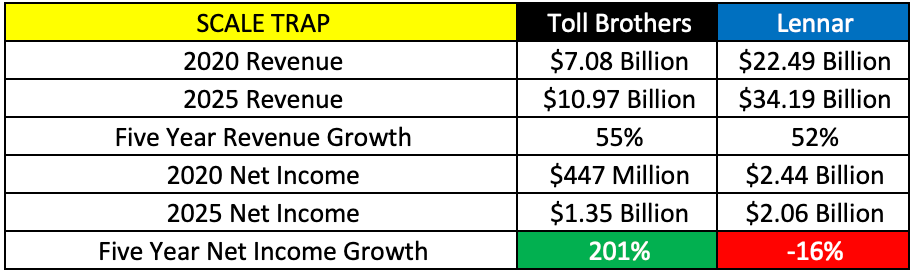
Five years of growth, two very different outcomes
Two of America’s largest homebuilders increased revenue by about 50% over five years. One tripled its profits. The other earned less than it did five years earlier. Same industry. Same interest rates. Same national housing cycle.
Very different results.
The difference wasn’t in how many houses they sold. It was in whom they built for, what they built, and what those buyers were willing to pay. That is the difference between growing a homebuilding company and building a valuable homebuilding business. That difference is why Toll Brothers’ results challenge the industry’s obsession with volume and why brand may be the most underrated moat in housing.
Only one of the major homebuilders in this comparison grew orders last quarter. It wasn’t the biggest. It was the most expensive. Toll Brothers increased signed contracts by 5% year over year. Lennar’s orders declined 9%, and KB Home’s orders fell 12%.
At first glance, that looks like a story about luxury housing. Look closer, and it becomes a story about strategy and about something the industry rarely addresses: brand.
Over five years, Toll Brothers and Lennar grew revenue at nearly identical rates. Their profits moved in opposite directions. That is the more important number. Revenue growth and unit volume are not enough. The quality of the earnings matters. Five years tell the story.
Consider the results from fiscal 2020 through fiscal 2025.
Sources: company filings and reported financial histories. Fiscal years differ; net income reflects total-company results.
The top line tells a familiar story: two major builders expanded revenue by roughly half. The bottom line tells a different story. Toll more than tripled its net income. Lennar generated nearly $12 billion more in annual revenue than in 2020, yet earned less.
To be fair, Lennar was not standing still. Its orders rose 9% in fiscal 2025, to nearly 84,000 homes. By the industry’s favorite measure, volume, it was winning. Scale generated more revenue, but it did not translate into better earnings. The buyer matters more than the unit count.
Toll Brothers operates in a different market segment. Its average delivered home price in fiscal 2025 was about $960,000, compared with Lennar’s at about $391,000.
Those buyers face different economic realities.
About 70% of Toll’s buyers in fiscal 2025 were move-up or move-down households, typically with equity in an existing home. Roughly a quarter, 26%, paid in cash.
Toll’s CEO, Douglas Yearley, said the company’s mortgage rate buydown take rate was “very low” because its buyers “do not need a lower rate to qualify for a mortgage.” That shifts the demand equation. A first-time buyer financing most of a $391,000 home lives and dies by the monthly payment. A buyer with equity and cash in hand is choosing a home, not qualifying for one.
Product, location, household wealth, financing needs and available alternatives all shape pricing power. A builder that understands its customer can make different decisions about price, incentives, product, and pace than a builder competing in a payment-sensitive segment.
The objective isn’t to sell the most houses. It’s to sell the right houses to the right buyers at a margin that holds. Margin is where strategy becomes measurable.
In fiscal 2025, Toll reported a 25.6% gross margin on home sales, or 27.3% using its adjusted measure. Lennar reported 17.7%. That gap is almost 10 points per home sold.
Gross margin isn’t net income, and a single comparison doesn’t prove that one strategy is superior across all markets. Product mix, land costs, geography, overhead and other business lines all affect the outcome. But the gap shows that unit volume alone is an inadequate measure of performance. Every home carries an economic result. Incentives, construction costs, land basis and the capital tied up before closing all shape that result.
When demand softens, a builder can defend its pace with incentives. Lennar said it was running about 14% in incentives and price adjustments at the end of fiscal 2025 and about 12% this past quarter. Toll’s average incentive in fiscal 2025 was about 8%. Incentives can be the right call in a given market. But they are a choice to trade margin for pace. Repeated quarter after quarter, they stop being a tactic and become the business model.
There is no virtue in protecting volume if the economics of that volume deteriorate.
Brand is the moat
Here is what the spreadsheets miss. When I was at KB Home, I learned that this business is really three things: brand, land and moat. Most builders obsess over land. Fewer think seriously about brand. And almost none treat brand as the moat, the thing that protects their margin when the market turns. Toll Brothers does.
Founded in 1967, Toll calls itself the nation’s leading builder of luxury homes. In 2026, Fortune named Toll the No. 1 home builder on its World’s Most Admired Companies list, the ninth time it has earned that ranking. That reputation was built over decades and shows up in the numbers.
Look at what Toll’s buyers spend after selecting a base price. In Q4 of fiscal 2025, buyers spent an average of about $206,000 per home on design studio selections, structural options, and lot premiums. That’s roughly 24% above the base price.
Think about what that means. Most builders spend money to get a buyer to sign. Toll’s buyers spend money to make the home their own. One business buys demand with incentives. The other earns it with a brand. That is what a moat looks like in housing.
A brand doesn’t eliminate cycles. Toll’s adjusted gross margin fell from 27.5% to 25.6% this past quarter, and its earnings declined. Luxury buyers feel uncertain too.
But a brand changes how a builder experiences a downturn. It gives the company room to hold prices, to let buyers personalize instead of discounting, and to compete on what the home means rather than what it costs. When every builder is fighting for the same payment-sensitive buyer, the one with a brand has a different conversation.
Scale can be copied. Land can be bought by anyone with capital. A brand that buyers trust and will pay for takes decades to build and is very hard to take away. Scale should create an advantage, not become the objective. Large builders have real advantages: purchasing power, access to capital, national vendor relationships, established processes, and the ability to spread overhead across more communities. But those advantages only matter when they improve the economics of the individual market.
Housing is not a uniform national product. Jobs, affordability, land costs, infrastructure, buyer preferences, and competing supply vary by market, often by submarket. A strategy that works in one geography can fail in another. A product that appeals to one buyer can miss the mark with the next. And land bought at the wrong basis can wipe out efficiencies elsewhere.
The answer isn’t to abandon scale. It’s to make scale serve local economics, customer demand, and the brand. That requires discipline in deciding where to build, what to build, whom to build for, how much land to control, and how much capital to commit.
A lesson for the industry
Toll Brothers’ results do not prove that expensive homes always outperform affordable ones. One quarter does not crown a long-term winner, and the first-time buyer market is essential to American housing. But Toll’s results challenge an assumption that has shaped homebuilding for years: that more volume, more markets, and more scale necessarily produce a stronger business.
The five-year comparison raises a bet
Source: www.housingwire.com — article syndicated from the publisher’s feed; all rights remain with the original publisher.