
‘It’s Hand-To-Hand Combat’: Prologis Exec On Chicago Industrial Strategy
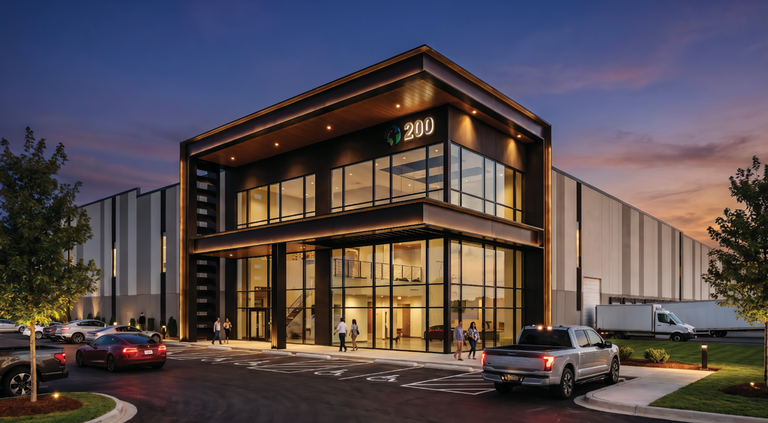
One of the most prolific developers of industrial real estate across the country is doubling down on its intentions to continue building in Chicago.
Industrial behemoth Prologis is bucking Chicago-area market trends and actively pursuing new ground-up development even as the overall construction pipeline has fallen to about a third of what it was four years ago.
Courtesy of PrologisA rendering of Minooka Exchange, a proposed Chicago-area development from Prologis
The company is getting creative to execute infill development in the area, Prologis Senior Vice President and Investment Officer Josh Zemon said at Bisnow‘s Chicago Industrial Summit at the Renaissance Chicago O’Hare Suites on Wednesday.
“It’s hand-to-hand combat. It’s very hard, but that’s what makes these opportunities so special,” Zemon said. “You’re going to see more and more of Prologis doing projects like that on spec, and we’re just deeply convicted in the strategy.”
Prologis has beefed up its Chicago-area development pipeline in the past several months, acquiring sites in Glendale Heights and Minooka earlier this year. Late last month, it entered into a joint venture with Gaming & Leisure Properties to develop a 3.8M SF industrial park on the former Hollywood Casino Joliet site.
Zemon said Prologis’ Chicago strategy is shaped around what its customers are telling the company. It is betting on infill development in submarkets where barriers to entry are high and building large properties that have few vacant, high-quality alternatives in the market, he said.
Overall industrial construction activity is a far cry from Chicago’s peak: The amount of space under construction was 11.4M SF in the third quarter, according to Colliers, down from more than 37M SF at the peak in Q3 2022.
The combination of a slow construction pipeline and leasing activity that has concentrated on users upgrading their Class-B and C spaces allows for continued rent growth on new development, Zemon said. The rent growth offsets higher interest rates and higher cost of capital.
“We’re not doing every deal that gets put in front of us,” he said. “We are very disciplined, and we’re only looking at certain opportunities and certain submarkets that we have high conviction in. But it’s still green light for development because of these reasons.”
Bisnow/Ryan WangmanArco/Murray’s Brent Jordan, Clarius Partners’ Taivo Tammaru, Colliers’ Diana Perez, Prologis’ Josh Zemon, The Missner Group’s Barry Missner and Liston & Tsantilis’ Peter Tsantilis
As with many developers, Zemon said access to power is table stakes for getting projects off the ground. Part of its infill strategy is redeveloping sites that already have ComEd service, the electricity provider in the Chicago area.
At its Joliet site, Prologis set up an in-person meeting with ComEd “Day 1” to make sure it didn’t take power away from the former casino, Zemon said. Existing power is a massive advantage for development, he said.
Zemon doesn’t see a clear path for how supply will catch up to demand, with minimal land sites available and most deals requiring land assemblages and complicated entitlements.
“This market is still very in check from a new-supply perspective,” Zemon said. “We’re not going to ever get back, in my opinion, to 20M SF or 30M SF under construction at one time. It’s just too damn hard.”
But even if the overall market doesn’t ramp up to its peak construction pipeline, Zemon said he is confident Prologis will remain active.
“As long as there’s good customer activity, we’re going to continue to be bullish,” Zemon said. “We’re going to continue to develop new real estate, acquire real estate.”
Source: www.bisnow.com — article syndicated from the publisher’s feed; all rights remain with the original publisher.