
D.R. Horton tests Promise Robotics factory model for 1,250 homes
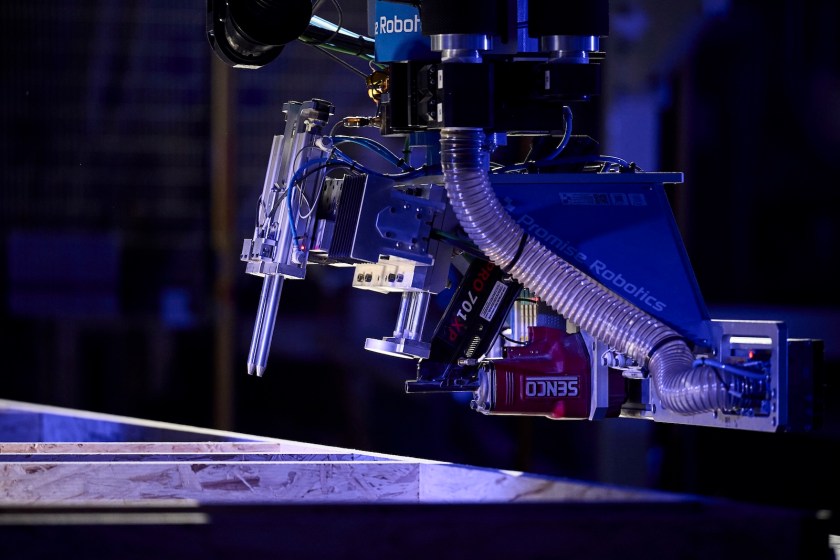
D.R. Horton, the nation’s largest homebuilder, is partnering with Promise Robotics to integrate AI-powered manufacturing into its production operations.
The multiyear agreement will test whether industrialized construction can deliver the speed, cost discipline and capital efficiency that homebuilders need. Even the nation’s largest homebuilder, with the scale, purchasing power and market presence to outperform most competitors through difficult housing cycles, still needs to become a more capable, efficient and economically productive enterprise.
Despite that need, earlier generations of construction technology startups have struggled mightily to achieve economic viability and going-concern sustainability in a more unforgiving-for-longer cost-of-capital era.
D.R. Horton is not waiting for lower mortgage rates, stronger consumer demand or relief from persistent construction labor and cost pressures to make ongoing investments and commitments to operational improvement. Instead, the Arlington, Texas-based homebuilding giant is extending a decade-plus commitment to construction and operational innovation into a new frontier: artificial intelligence that performs physical work.
D.R. Horton and Toronto-based Promise Robotics this morning announced a multiyear commercial agreement that will give the homebuilder access to the technology company’s Factory-as-a-Service production platform to support construction of more than 1,250 homes.
The agreement makes D.R. Horton the first major U.S. homebuilding enterprise to adopt Promise’s integrated robotic manufacturing system as the startup expands its American production network.
For D.R. Horton, whose senior leadership has spent years improving land acquisition tactics, construction cycle times, product design, purchasing, and operational efficiency as ongoing value creators for shareholders and homebuyer customers, the agreement represents another investment in capabilities it can control, even as market conditions marked by risk, uncertainty, and volatility remain beyond its influence.
“At D.R. Horton, we are always looking for innovations that can help us improve how we build. We are continuously focused on improving cycle times, increasing production capacity, and bringing greater consistency and predictability to our operations,” said Brad Conlon, senior vice president of strategic growth and innovation at D.R. Horton in a provided statement. “Promise Robotics’ integrated platform gives us a new capability to support those goals.”
The announcement also raises a critical question for the homebuilding industry and the venture capital community backing its transformation: Can the newest generation of construction technology enterprises overcome the capital intensity, adoption barriers and housing market cyclicality that have defeated earlier attempts to industrialize homebuilding?
The advantage of getting better when the market gets worse
For D.R. Horton, the strategic logic extends beyond the immediate production commitment. The company already operates at a scale that enables it to spread overhead, coordinate purchasing, and leverage local market density more effectively than smaller competitors.
But size alone does not eliminate construction variability, trade labor constraints, or the financial consequences of delayed home completions. Each day removed from the construction cycle can reduce carrying costs, accelerate inventory conversion, and improve the productivity of capital invested in land and homes under construction.
That urgency has intensified as stepped-up federal immigration enforcement disrupts an already strained residential construction workforce. As The Builder’s Daily reported last week, builders in some markets have experienced severe losses of available trade crews, with framing delays cascading into missed completion dates, higher carrying costs and postponed closings. Even as weak housing demand reduces overall construction activity, builders in affected markets are finding that the skilled labor they need to finish homes already under construction is becoming less dependable.
That makes Promise Robotics’ production model more than a long-term bet on efficiency. By shifting labor-intensive framing tasks to AI-orchestrated manufacturing facilities, builders could reduce their exposure to increasingly unpredictable jobsite labor capacity while improving production consistency. The technology cannot eliminate the need for skilled trades, nor can it erase the broader workforce crisis. But it offers D.R. Horton a potentially effective way to produce more with the labor resources available, rather than waiting for outside intervention to restore those resources.
Those improvements become especially valuable when homebuilders must offer incentives and price concessions to sustain sales absorption, pressuring margins even as they work to maintain production capacity.
The Promise agreement gives D.R. Horton the opportunity to test a different production model without assuming the full capital and operational responsibilities of owning and operating robotic manufacturing facilities.
Promise Robotics co-founder and CEO Ramtin Attar emphasizes that distinction as a bulwark of the company’s strategy.
“We’re not going to disrupt your operation. We’re going to do exactly what you’re doing today. We’re going to just give you the capacity and give you the transparency,” Attar told HousingWire TBD in an exclusive interview ahead of the announcement.
Rather than requiring a builder to retool and reengineer its entire construction lifecycle, Promise begins with familiar framing components, such as walls, floors, and stairs, and automates their manufacturing and assembly as workflow plug-ins.
The approach is deliberately narrower than the sweeping factory-built housing transformations that drew substantial investment in the previous decade.
What physical AI actually does
Promise Robotics describes its technology as physical AI because its software does more than analyze building plans or recommend construction sequences. It directs robotic systems to manipulate building materials and perform manufacturing tasks.
Image courtesy of Promise Robotics
The process begins with a homebuilder’s existing architectural designs. Promise converts them into data-driven, manufacturing-ready models that specify components, materials, product variations and production sequences.
Its software then sends manufacturing instructions to local factories, where automated systems produce building components for delivery to construction sites. Trained installation crews assemble those components into the home’s structural framework.
Attar said the system can assemble the framing for a typical two-story, 1,800-square-foot house with a basement and an attached garage in about eight hours. More complex duplex projects generally require two to two-and-a-half days.
Those figures describe assembling structural components, not completing an entire home. They also do not establish the total construction cycle savings D.R. Horton will achieve, which will depend on how the process integrates with subsequent trades and inspections.
A faster framing o
Source: www.housingwire.com — article syndicated from the publisher’s feed; all rights remain with the original publisher.