
In Sun Belt Multifamily, an Uneven Path Back Toward Boom Times
A rising tide lifts all boats, but not all of them find their moorings at the same time.
That’s the case with multifamily housing across the Sun Belt, where the uneven retreat of regional oversupply from a nearly decade-long construction boom means regional markets are returning to more normal conditions at very different rates.
When multifamily housing construction across the Sun Belt shifted into overdrive during the pandemic, fueled by renter migration to warmer climates and cheap financing, an apartment glut was almost inevitable. Rents jumped 30 percent from 2021 to 2024, and new inventory grew by 673,000 units, according to data firm Yardi Matrix.
At the time, the industry consensus was that the oversupply would be absorbed within two years. That hasn’t happened uniformly.
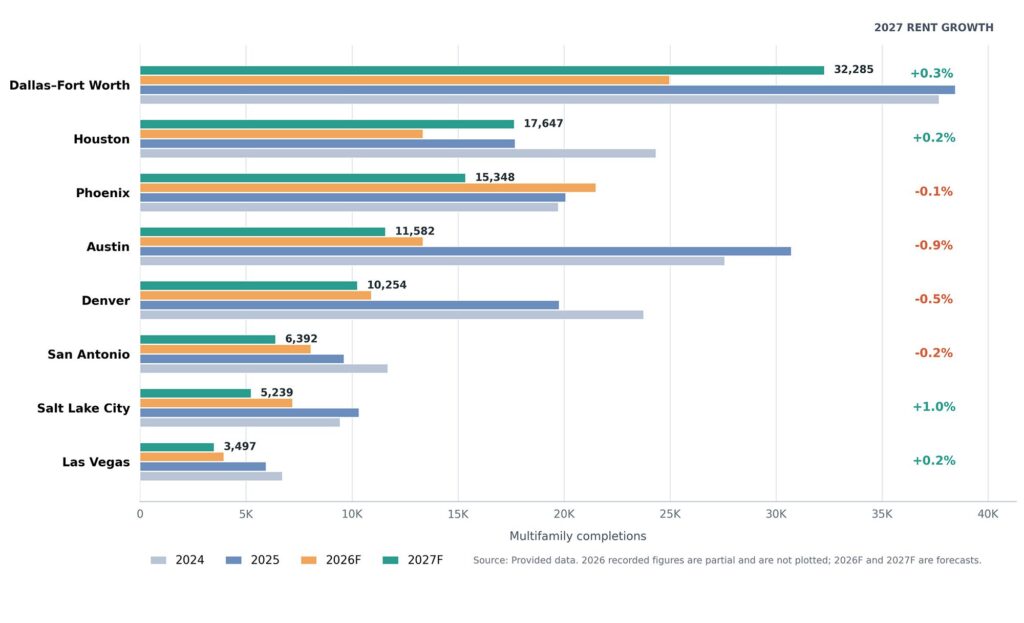
Yardi originally expected high-supply markets to return to positive rent growth by the end of 2026. By late 2025, the company revised that view, noting in a report that construction starts had declined sharply, absorption of new units had improved across most oversupplied markets, and recovery was still coming. Positive rent growth for all major high-supply markets was now expected by year-end 2027.
The Sun Belt market’s transition is layered, made even more complicated by the Federal Reserve’s September interest rate hike. While rates increased just a quarter of a percentage point, it’s enough to change the math for developers and investors, and Fed watchers believe another hike could happen before the midterm elections.
John Orsak, an executive vice president at the global real estate developer and property manager Lincoln Property Company, headquartered in Dallas, said he’s seeing considerable variation across the Southwest markets. From his Phoenix office, he said the recent shift in monetary policy is another sign that the post-boom environment will be less volatile.
Multifamily completions in Sun Belt cities for 2024 and 2025, with estimates for 2026 and 2027. CHART: Commercial Observer
“It cuts both ways, in the sense that we’ve got ourselves into this oversupply situation because of cheap money, and we’re going to chew through that, and we’re going to get back to a balanced market,” Orsak said.
He added that 2027 and 2028 may even produce an “air pocket,” with some increased demand because of more expensive money.
“Everyone is moving in the same direction,” Orsak said. “They’re just at different points on the curve.”
In South Florida, a highly charged component of the Sun Belt market, Gay Cororaton, chief economist at Miami Realtors + RWorld, said there’s similarly uneven data for the region, with Miami’s rental market getting tighter and more expensive, with a vacancy rate of 6.4 percent for August, slightly down from 6.8 percent in July. However, other areas, such as Port St. Lucie, had its vacancy rate edge upward to 7.5 percent from 7.2 percent. Tampa’s vacancy rate hit 8.5 percent, according to data from Apartment List.
“The inventory conditions are very different across South Florida, but I wouldn’t say there’s an oversupply in the Miami and Port St. Lucie metro area,” Cororaton said.
Supply debates aside, migration — that great driver of the pandemic-era Sun Belt boom — has clearly ebbed. An analysis of census data for the 50 most populous metros
found steep year-over-year slowdowns in migration.
According to a Redfin report, Tampa’s domestic population inflow dropped 70 percent in a single year, Orlando’s nearly vanished, and Atlanta flipped from a net gain of 16,663 to a net loss. Florida’s statewide domestic net migration fell from 314,000 in 2022 to roughly 64,000 in the most recent data, an 80 percent decline from its pandemic peak. Texas still ranked No. 1 nationally with about 76,000 net domestic migrants in 2024, but that was down 44 percent from roughly 136,000 in 2023.
Still, even with migration, variation reigns. Phoenix’s net domestic inflow actually increased, from 19,378 to 21,364, and Las Vegas surged from 5,069 to 12,225, according to Census data.
Rising costs are part of the reason for the slowdown elsewhere. Price appreciation in several Sun Belt metros has narrowed the affordability advantage that first drew people. In parts of Florida, rising property insurance costs and climate concerns are giving potential newcomers pause.
The current federal administration’s immigration policies are also playing a role, as an overall decline in foreign arrivals is weighing on renter demand. The Census Bureau projects that the net immigration of 1.3 million recorded in the year ending June 2025 could fall to around 321,000 in the year ending June 2026, with notable weakening migration to the Sun Belt, where the arrival of 357,800 people in 2025 was the lowest total since 2018. From 2021 through 2024, immigration accounted for at least two-thirds of all net renter household growth nationally, reaching 100 percent in some regions, according to a recent report from the U.S. Department of Housing and Urban Development. Wherever the source, the renter migration pool is shrinking: Domestic renter mobility fell to 21.6 percent in 2026, down from 26.7 percent in 2014.
If you don’t blow air into it, a bubble doesn’t grow, making the decline in national multifamily starts a sure sign of a rebalancing market. In May, reports that construction starts had hit a 15-year low offered daunting data. First-quarter 2026 starts fell to just 55,000 units nationwide, the lowest quarterly level since 2011 and 73 percent below the early 2022 peak.
The slide is even more pronounced across the Sun Belt where the construction pipeline has retreated to 2016 levels. The region still faces a supply overhang, but starts in early 2026 were roughly 75 percent below their 2022 high, and units under construction have fallen to 2016 levels, as Marcus & Millichap noted in a recent report.
A recent PwC report cited Sun Belt markets Orlando, Austin, Miami, Nashville and Phoenix as still having a pipeline imbalance. What’s more, a further 4 to 5 percent will be added to rental housing stock in certain metros in 2026 and 2027.
And deliveries are falling fast. After a peak of 696,000 new units nationally in 2024, deliveries fell to 531,000 units in 2025, and the market is on track for about 421,000 units this year. Apartment deliveries are expected to fall another 24 percent in 2027, according to CoStar data.
Orsak at Lincoln said there’s plenty of regional variation, particularly in the Southwest. Austin’s quarterly absorption hit a new record in the summer and recorded some modest rent growth — “a huge turnaround.” He added that Houston posted its largest quarterly vacancy improvement in about five years in the same
Source: commercialobserver.com — article syndicated from the publisher’s feed; all rights remain with the original publisher.